

SA News Agency
It is said that a journey of 1000 miles starts with a single step and that single step can open doors to much-needed employment or the start of an entrepreneurial voyage.
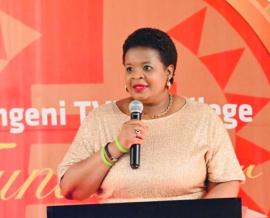
“For me the success of our sector is not in just skilling and training but in ensuring that we’re training and skilling for employability. That is where our success lies in that where do our students end up once they emerge from the sector? Are they able to then be absorbed into the economy and employability? I’m not just talking about working for someone, I’m talking about self-employment and entrepreneurship,” Higher Education and Training Deputy Minister, Dr Mimmy Gondwe, told SAnews.
Describing herself as a “very simple person and a hard worker,” Gondwe, who was appointed as Deputy Minister on 30 June 2024, says that her passion is around ensuring that there is collaboration with the private sector “and that we really produce skills and training that is needed and demanded by the economy.”
“In other words, our approach to skills development should be demand-led and of course, opportunity led. We have to skill for the future, and not just for the now and the immediate future,” she said during an interview held at the department’s offices in the Pretoria central business district (CBD).
Skillset
On whether the country is producing the right skillset needed by a changing world of work, Gondwe said this work is ongoing.
“We are trying to do that, as I said I’m really passionate about partnerships that will ensure that the skills and training that we produce are needed and demanded by the economy and we skill for employability, not just to tick boxes to say we’ve skilled so many young people coming out of the system.”
She emphasised that South Africa’s economy is unlikely to absorb all the young people that come from the higher education sector.
“So we need to see more young people starting their own businesses, enterprise development is very important, and we do have enterprise hubs at our TVETs [Technical and Vocational Education and Training] and Centres of Excellence which are focused on ensuring that we get skills that are needed by various sectors of the economy.
“I think we need to embed enterprise in the curriculum so that it’s not a here or there [situation], but young people know that they have that option and it’s not always that you exit the system and go work for somebody, but you can work for yourself.”
That way she added, young people could employ themselves and others.
“I think we need to ramp-up a bit there in terms of enterprise development, perhaps even find a way to incentivise more young people to start their own businesses.”
Priorities
Since assuming office, partnerships with the private sector, the Matric Support Programme and addressing water and sanitation issues at institutions of higher education have been some of her priorities.
“I’m very passionate about seeing partnerships between the private sector and the department and its entities and that is to bridge the gap between the world of work and our institutions and to make sure what we are offering is what is needed and demanded by industry and by the economy and that our students once they exit, will have the relevant skills.
“I want to reiterate: it’s not just about skilling and training. We have got to skill and train in skills that are needed and demanded by the economy so that our students can then find employment. We have to skill for employability and so I’ve been very passionate about that and going out and speaking to the private sector about partnering [with us],” she said.
To date she has signed three Memorandums of Understanding (MoUs) with Old Mutual, Microsoft and Takealot. Signed in September, the agreement with the Takealot Group aims to expand youth skills development, bridge education-to-employment gaps, and support workforce growth in South Africa.
The MoU between the department and Microsoft is on Artificial Intelligence (AI) and digital skills development and was announced in October. The three-year MoU aims to strengthen collaboration between the public and private sectors in preparing South Africa’s workforce for the rapidly evolving digital economy.
“We have four partnerships that are in the pipeline, including a partnership with an international partner around skills development and making sure that the skills that we offer really speak to what’s needed not only by the economy, but also outside of our economy in other countries.”
The Taking Higher Education to the People programme also sees the department visiting the most rural and under-resourced communities where it informs them about opportunities that are available in the higher education space.
“Also, we have the Matric Support Programme which is aimed at bridging the gap between basic and higher education. It is targeted at your matric students to just say to them: ’This is what you can expect. These are the opportunities that are available and we can’t wait to welcome you in our sector.’”
The department also engages in business and skills imbizos where it partners with local municipalities to get to the Neither in Employment, Education or Training (NEET) cohort.
“At some stage, we were sitting at 3.8 million young people that were neither in employment nor training. So, I thought we can’t always run our programmes at our institutions, lets partner with municipalities, that way we can then get to that NEET cohort and tell them about opportunities that are there outside of the university and TVET space. We do that with our SETAs [Sector Education and Training Authorities].”
She has also partnered with her Department of Water and Sanitation counterpart, Sello Seitlholo, around water and sanitation challenges at institutions. The two Deputy Ministers have assisted a college in securing seven water tanks for the college while waiting for the water authorities to sort out the projects that will ensure water provision not only for the TVET, but the greater community at which it is located.
Asked about when the three MoU’s will bear fruit, she said that “youth unemployment is not something we can ignore; we have to tackle it.”
“With the partnerships, they will soon start yielding results, most of them were signed recently. And if we can ensure that the next set is signed at the beginning of the year, we are going to ensure that these slowly but surely rollout. Some of these partnerships will benefit community colleges,” she said.
AI
Asked about her thoughts on whether AI is a threat or a gain in the higher education space, Gondwe said it is somewhat of a double-edged sword.
“It’s somewhat of a double-edged sword; there’s certain roles and responsibilities that are going to be replaced by AI but there are those that can’t. Artisans are so important. But through partnerships with Microsoft and other industry leaders in the ICT [ information and communications technology] space, we are ensuring that students have the right skills to be able to be competitive when it comes to accessing the market. I see it more as an opportunity for us to ensure that our students have the skills to meet what is needed by this AI generation,” she explained.
Safer campuses
Gondwe who is keen in making a difference in the lived experience of ordinary people, expressed concern over the student protest action experienced at some of the country’s campuses.
“We are concerned obviously because these are our entities. We don’t only want to offer quality education and training, but we also want to be able to do that in an environment that is conducive and safe, so it does concern us. The Minister is leading efforts to ensure that we are ready for the 2026 academic year,” she said.
She added that a war room has been established and that there is engagement with institutions. Recently the Universities of the Free State and Fort Hare University experienced protest action.
“The Minister [Buti Manamela] is leading those efforts. People assume that because maybe we are not talking about something a lot, we are not doing something about it. There are efforts to ensure that we engage VCs [Vice Chancellors] to ensure that we are ready for the 2026 academic year and our campuses are safer.”
Pathways to a better future
The Deputy Minister counts youth unemployment and ensuring that there are pathways for employment for young people as bugbears.
“The rate of unemployment, especially among young people, is alarming and worrisome. Being a mother as well, as my daughter will be in matric next year. I am determined to ensure that there are pathways for employment, for careers for young people and that we are not just skilling and training for the sake of training. Those days are gone. We have to really care about where young people end up and not to add to the unemployment queues,” she said.
It is clear that the Deputy Minister who adds that her leadership role does not mean that “I’m the paragon of all wisdom” and “listens to people a lot” is keen on ensuring that the journey of students does not end in a dead end.

Comments are closed.