

By Khumo Makame and Boipelo Mere
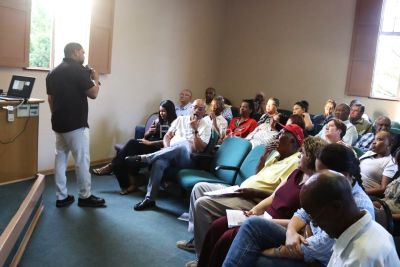
In commemorating Human Rights Month, Oral Historian from the McGregor Museum, Geronime Louw, took the opportunity to share developments in research started in November 2025 on a displaced community in Ronaldsvlei. The session was held at the McGregor on 12 March 2026.
This once thriving community was home to Asian, Malay, Black, White and Coloured people before being affected by force removals between 1950 and 1975, similar to Sophiatown and District Six.
Ronaldsvlei was referred to as “one big family” due to the intermarriage among families and the broader culture.
The Group Areas Act no.41 of 1950 was enforced by apartheid law in South Africa to segregate residential areas and businesses according to race.
Ronaldsvlei is situated next to Kimberley Airport and railway line, close to the N8 towards Bloemfontein.
In 1998, things turned out for the best for
the displaced Ronaldsvlei residents when a High Court Ruling under the Restitution of Land Rights Act 22 of 1994 resulted in 98% of Ronaldsvlei community members claiming their title deeds and those who were not interested in taking title deeds were compensated.
Ronaldsvlei Communal Property Association (CPA) was established to assist with the land claims process. Sherley van der Mollen conducted a verification process to ensure that claimants were related to or were the rightful owners of the title deed
In 1966, the then Government issued a notice stating that Ronaldsvlei would become a White-Only suburb, with plans and promises to provide basic services such as running water, electricity, expand the airport and the Military Base.
However, the White-Only surbub concept was abandoned. Thereafter, Ronaldsvlei citizens were classified and relocated according to race. Blacks to Galeshewe and Greenpoint, Indians allocated apartments in Mogul Park while Coloureds to Colville, Homevale and Roodepan, forcing them to start over after losing their livestock and possessions.
Ronaldsvlei was inhabited, under a 99-year lease agreement as early as 1900, whereby De Beers Mineworkers were relocated from Morgan’s (Wesselton Mine) to occupy it.
“Some were fortunate enough to buy a plot others were paying rent to the Department of Community Development. When the Native Urban Areas Act of 1923 was introduced, Ronaldsvlei became under the spotlight because of its diverse community,” said Louw.
Thirty indigenous households were forcibly removed as early as 1938 without receiving compensation or housing.
In 1999 Brian Anthony, Moses Alvin and Mervyn Ludick were the first families to return to Ronaldsvlie.
Alvin indicated that he used to live in Ronaldsvlei with his grandparents, John and Amelia, who was a domestic workers for the rich Vermeulens family who were staying in Beaconsfield. His father was a soldier at Diskobolosh Military Base near the Airport. The base only accommodated coloured and whites.
Currently, about 30 families live in Ronaldsvlei. The neighborhood remains a quiet, deserted area, mostly used for grazing, as basic services such as running water and electricity have not yet been prioritised. However, demand is growing as people seek to own a piece of this historical land.
Louw, interviewed former residents and descendants who shared personal stories. “The purpose of sharing the gathered information at this stage is to encourage more people to come forward and share valuable information with us, so that we can document Ronaldsvlei history for future generations”, he said. He mentioned the lack of resources as a challenge to obtaining information. “It is difficult to access information because everything is filed at the National Archives in Cape Town and the De Beers Archive has also moved their records to Johannesburg. We only rely on people that we can talk to”.

Comments are closed.